
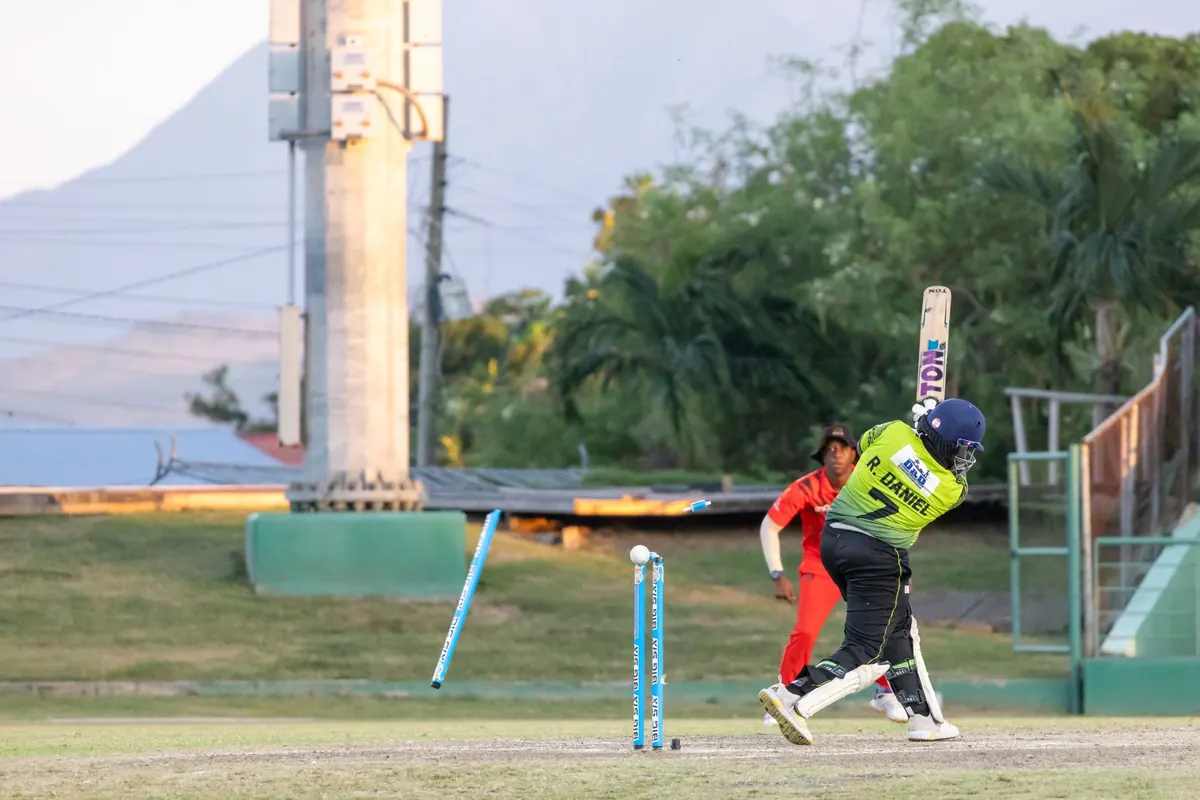

Five Bowling Run-Up Mistakes That Kill Pace and Accuracy
Watch a bowler walk back to their mark and you can often guess what is coming. Fidget with the marker, shuffle into a slightly different starting position, set off at a jog, sprint halfway, then jam on the brakes a stride before the crease. The ball arrives at 70 per cent pace, a foot outside off, and the bowler turns around wondering why the shoulder feels tight.
The run-up is not a warm-up act before the real delivery. It is the first half of the delivery. Whatever pace and accuracy you own gets built between the first step and the moment your front foot lands. A messy run-up produces a messy ball, no matter how good your wrist position is at release.
These are the five run-up faults that show up most often at club level, along with the drills that fix them.
1. Sprinting From the First Step
Pace in a run-up works like a car joining a motorway: you need a ramp, not a wall of acceleration. Bowlers who explode off the mark arrive at the crease already at maximum effort, which leaves nothing extra for the jump. The result is a flat delivery and a front leg that collapses because the rest of the body is playing catch-up.
A workable run-up has three phases: a steady build, a controlled gather, and a short, fast final approach. The first few strides should feel almost gentle. The middle holds the rhythm. The last three or four steps are where the speed actually comes from.
Drill: the three-zone run
Mark your run-up with two cones: one at your start, one roughly two-thirds of the way through. The first zone is your build, the second your gather, and everything past the last cone is the fast finish. Bowl six balls and check that your feet are still hitting the same spots by ball six. If you are gasping by ball three, you started too hard.
2. A Run-Up That Changes Every Over
If your starting point shifts by a metre each over, your front foot lands somewhere different every time. You then spend the delivery adjusting, and adjusting mid-delivery is how no-balls, leg-side wides and half-volleys happen.
Two habits cause this. Bowlers pace out a run-up in metres rather than strides, and a metre is a different number of steps depending on how tired they are. Others simply walk back until it "feels right", which changes with fatigue, weather and nerves.
Fix it once. Measure the run-up in strides, in your spikes, on a dry day, at the ground you play on most. Mark the start with something you can find again: a cone, the edge of a slab, a scuff in the turf. Then treat that mark as fixed.
Drill: the counted walk-back
Stand at the crease, turn around and walk back to your mark counting strides out loud. Do it five times. If your count varies by more than one stride, slow the walk down. Then bowl ten balls from that mark and note where the front foot lands. A consistent start creates a consistent landing.
3. Slowing Down Before the Crease
This is the most common pace-killer at club level, and it is usually invisible to the bowler. The last two strides get shorter, the body sits back, and you arrive at the crease with no momentum to transfer into the jump. It looks like a stutter. It feels like a jump that goes nowhere.
Deceleration usually happens for one of three reasons:
- The run-up is too long and you are tiring before the end of it.
- You are worried about overstepping, so the last step gets shortened.
- The jump is mistimed, so the body protects itself by putting the brakes on.
Whichever it is, the cure is rhythm. Your run-up should have a shape — something like da-da-da, da-da, d-da-dum — where the final three steps are the quickest and shortest. Not longer. Quicker.
The last two steps decide the ball; the first ten decide the last two.
Drill: rhythm counts and short-run bowls
Bowl off four or five paces counting "one, two, three, four — go". The count forces the rhythm. When that feels smooth, extend to your full run-up keeping the same final three steps. If the rhythm disappears, the run-up is too long. Cut a stride or two and bowl again.
4. Jumping Early, or Hardly Jumping at All
The jump is not a high jump. It is a transfer of horizontal speed into the delivery. Bowlers who jump early lose that transfer, land flat-footed and bowl with the arm only. Bowlers who barely leave the ground tend to push the ball rather than whip it.
Two checkpoints matter. The back foot should land close to the crease, under the body. And the jump should carry you forward, not upward — height is a by-product, not the goal. If you land on a straight, locked front leg with your weight behind it, you have probably jumped too early or too vertically.
Drill: bound, land, drive
Stand at the top of your run-up. Take three steps and a small bound forward onto your back foot, then drive your front foot into the ground and hold the landing for two seconds. Do ten of these without a ball. The aim is to feel your weight travelling forward through the crease. Add a ball once the landing feels stable.
5. A Delivery Stride That Is Too Long or Too Short
The delivery stride is the distance between your back foot landing and your front foot landing. Get it wrong and everything above the waist has to compensate.
Too long, and the front leg braces while the hips sit behind the ball, so you push it rather than bowl it, and the lower back takes the strain. Too short, and you fall into the delivery with no base, which usually means falling away to the off side and losing the stumps as a target.
Here is a simple way to check. Ask a teammate to mark where your back foot lands and where your front foot lands on three good deliveries. Measure the distance between the marks. If you cannot repeat it within a hand-span, your delivery stride is being decided by chance rather than habit.
Drill: the marked run-through
- Bowl five balls at three-quarter pace while someone marks your back-foot and front-foot landings.
- Step out the distance between those marks and note it in your own foot lengths.
- Bowl another ten balls aiming only to hit those marks, not to hit a target.
- Once the marks are consistent, put a single stump down and bowl at it.
Do this twice a week for three weeks and the delivery stride stops being a lottery.
Building the Fixes Into Your Week
Do not try to fix all five faults at once. Pick the one costing you most — usually the stutter into the crease — and work on it for two or three sessions. Ten focused minutes at the start of training, before you are tired, beats an hour of aimless bowling at the end.
A pattern that works well:
- Session one: run-up and rhythm only. Short run, no target, counting steps.
- Session two: full run-up with marked landings. Ten balls, checked by a teammate.
- Session three: full pace at a single stump, aiming for six balls to land where you want them.
Film yourself side-on if you can. Most bowlers are genuinely surprised by what their last two steps look like. Watch the feet, not the ball.
Finally, if something in your back, knee or shoulder is hurting rather than just aching, get it assessed by a physio or doctor before you bowl through it. A run-up fault can be fixed in a fortnight; a stress injury cannot.
Photo: Jermaine Lewis / Pexels